What Engine for an OVNI?
From diesel engines to electric propulsion: new paths to energy autonomy on board
On a blue water sailing yacht, propulsion is about far more than power alone. It plays a full part in the sailing experience and must meet a range of requirements: safety, autonomy, reliability, ease of use, energy management, on-board comfort and a reduced environmental footprint.
At ALUBAT, the OVNI range is currently built around a 50 hp Volvo diesel engine: a single engine on the OVNI 370 and OVNI 430, and two engines on the OVNI 490. This is a solution proven over years of sailing reliable and well suited to the demands of a blue water yacht.
But the world of sailing is changing, as are the expectations of those who go to sea. New needs are emerging, new technologies are developing, and with them, new ways of thinking about energy autonomy on board.
Energy autonomy: a new challenge for blue water sailing
On board a yacht designed for long-distance voyaging, energy needs have kept growing. Watermaker, refrigeration, electronics, heating, winches, windlass, bow thruster, cooking appliances: energy is now at the heart of life on board and of the ability to travel independently.
The search for autonomy has therefore become a major topic, particularly for sailors who want to do without port infrastructure and extend their stays in the most remote locations.
At the same time, another concern is coming to the fore: reducing, as far as possible, the impact of sailing on marine environments.
In this respect, silence becomes a real advantage. It limits noise disturbance for marine wildlife and allows for calmer sailing, particularly welcome during port manoeuvres and at anchor.
Access to protected natural areas is also set to change. Some zones may gradually restrict, or even ban, the use of combustion engines. Thinking today about new propulsion and autonomy solutions is also a way of preparing for tomorrow's voyages.
2023: a client sets us on the path to electric propulsion
At ALUBAT, innovation starts first and foremost with listening. Your projects, expectations and experiences have always shaped our thinking and encouraged us to imagine new ways of sailing.
In 2023, one of our clients asked us to design his OVNI with electric propulsion. For him, this was an essential condition of his purchase.
We chose to take up the challenge.
This first project allowed us to explore, in practice, the challenges of electric propulsion applied to a blue water yacht: system integration, energy management, charging, equipment power supply and the overall balance of the system.
Interest in this solution has kept growing ever since. Eight OVNIs have already been fitted with electric propulsion, allowing us to build on our experience and refine our approach. We design electric propulsion as a genuine energy system, conceived as a whole and tailored to the demands of blue water sailing.
BellMarine: electric propulsion designed for blue water sailing
The solution we offer is built around a BellMarine electric motor, combined with a Lithium LiFePO4 battery bank and a generator. The whole is designed as a coherent system, in which every energy source contributes to the autonomy and peace of mind of the voyage.
On a blue water yacht, the generator plays an essential role. It provides a complementary energy source and an extra safety margin when sunlight or regeneration conditions are not enough to cover all the needs on board.
The aim is to combine several energy sources:
- the Lithium LiFePO4 batteries, which store the available energy and power the various equipment on board;
- the solar panels, which provide daily output and help preserve energy autonomy;
- the generator, which takes over when the available output is no longer sufficient;
- regeneration under sail, thanks to the propeller, which converts the boat's motion into electricity from 5 knots of boat speed under sail.
Cette complémentarité permet de penser l’énergie à l’échelle du bateau dans son ensemble, plutôt que de considérer la propulsion comme un système indépendant.
This combination makes it possible to think about energy at the scale of the whole boat, rather than treating propulsion as a stand-alone system.
Electric propulsion thus becomes one component of an overall energy architecture, designed to meet the demands of blue water sailing.
The choice of 48 volts: a new way of managing energy on board
One of the major benefits of this solution lies in its 48V electrical architecture.
By increasing the voltage for an equivalent power output, the required current is significantly reduced. Cables can therefore be smaller in section, resulting in an installation that is lighter, more efficient and easier to integrate on board.
But the benefits of 48V go well beyond the wiring. Above all, this architecture makes it possible to centralise a large part of the boat's energy needs around the main battery bank.
There is no longer any need for multiple dedicated batteries to power equipment located further away, particularly at the bow, such as the windlass or the bow thruster.
A large share of the equipment can therefore run directly on 48V: windlass, bow thruster, electric winches, watermaker, and so on.
For equipment that remains on 12V such as lighting, refrigeration or electronics a dedicated battery, itself charged from the 48V bank, provides their power supply.
Towards a gas-free boat
This architecture also paves the way for another important development: doing without gas on board.
With sufficiently sized energy production and storage, cooking can be handled by an induction hob and an electric oven.
This is a change that simplifies life on board while improving safety: no more gas bottles to store, no handling constraints, and no need to hunt for the right adaptor depending on the country or cruising area.
Producing your own energy, rather than simply consuming it
The value of this approach also lies in a new way of thinking about energy on board. Batteries are no longer just a reserve to draw on: they become the heart of a system capable of producing, storing and delivering energy according to the boat's needs.
On OVNIs fitted with this technology, solar panels play an essential role in this daily production. But energy can also be recovered while under way.
Under sail, the propeller can run in regenerative mode, converting part of the energy produced by the boat's movement into electricity. The boat then generates power while continuing on its way.
This regeneration capability is particularly valuable on a blue water yacht: after several hours or several days of sailing, a significant amount of energy can be recovered and stored in the batteries in this way.
An approach that turns every mile sailed into an opportunity to generate the energy the voyage needs.
Silence
a new kind of sailing comfort
Electric propulsion also profoundly changes the way sailing is experienced.
Its remarkable quietness restores a more direct relationship with the sea and its surroundings.
In port, at anchor or on a short outing, the silence of the motor immediately changes the atmosphere on board. Vibration is greatly reduced drive is still provided by a shaft line and the absence of engine noise leaves room for the sounds of the sea and the wind. Even under power, the sensation of gliding over the water remains intact: a gentler, calmer way of sailing that naturally brings you closer to the pleasure of sailing itself.
This discretion is also an asset for sensitive marine environments, reducing the noise disturbance associated with propulsion. It comes into its own in anchorages and protected natural areas, where the desire to sail with greater respect for the environment is set to play an increasingly important role.
Torque, power and precision when manoeuvring
Electric propulsion brings a new sense of ease to manoeuvring, not only through its quietness but also through the immediate availability of its power.
Electric motors deliver strong torque from very low revs.
This instant response is especially valuable in situations that call for finesse and control: tight harbours, reversing, low-speed approaches or precise positioning.
Power is immediately available, with very smooth progression, giving the helmsman a sense of control that is particularly welcome in confined spaces.
For a centreboarder like the OVNI, designed to sail in a wide variety of environments, this precision is a genuine asset. Electric propulsion does more than simply move the boat: it allows it to be manoeuvred with greater finesse and confidence.
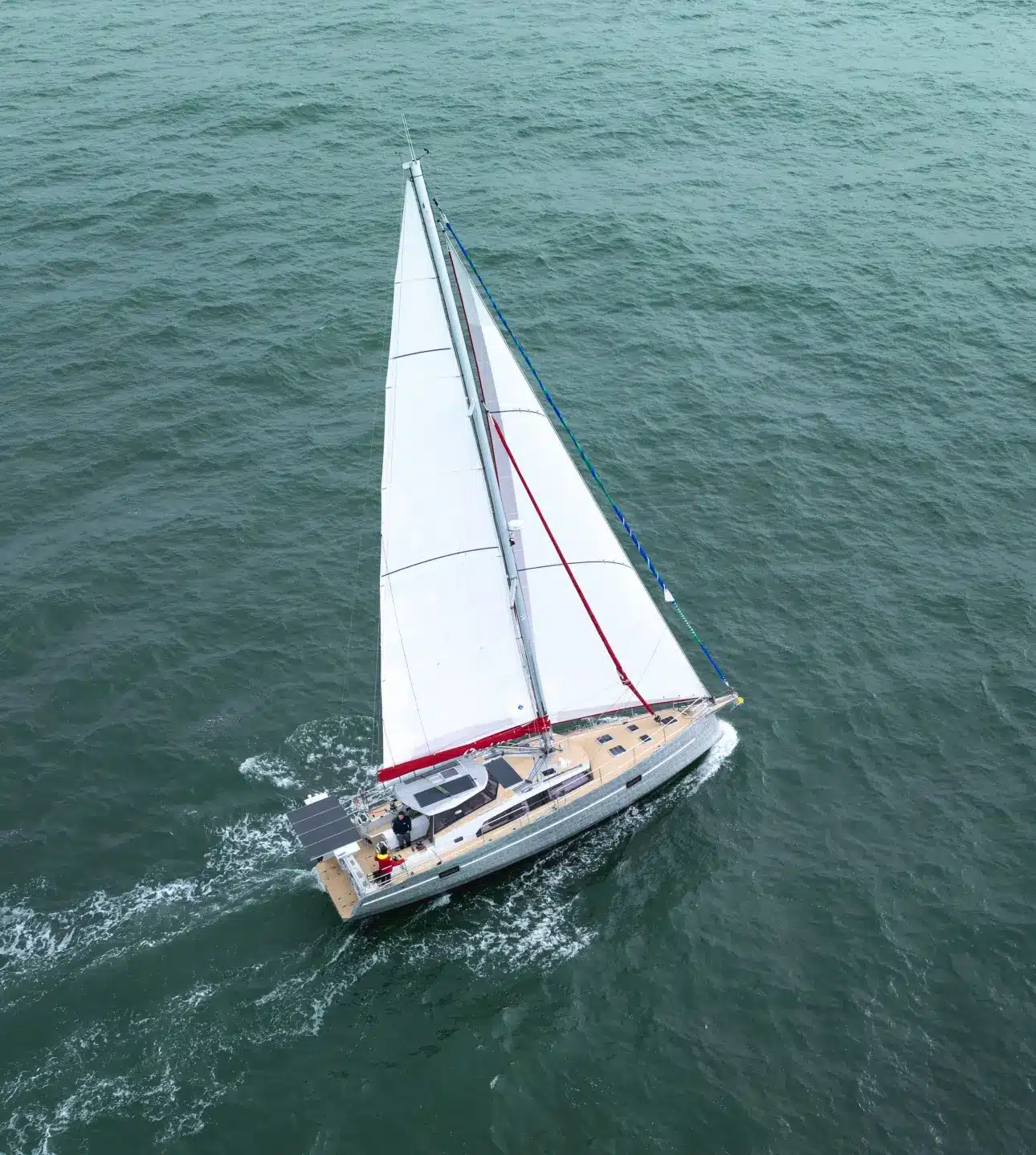
Motor sailing: when propulsion extends the reach of the sails
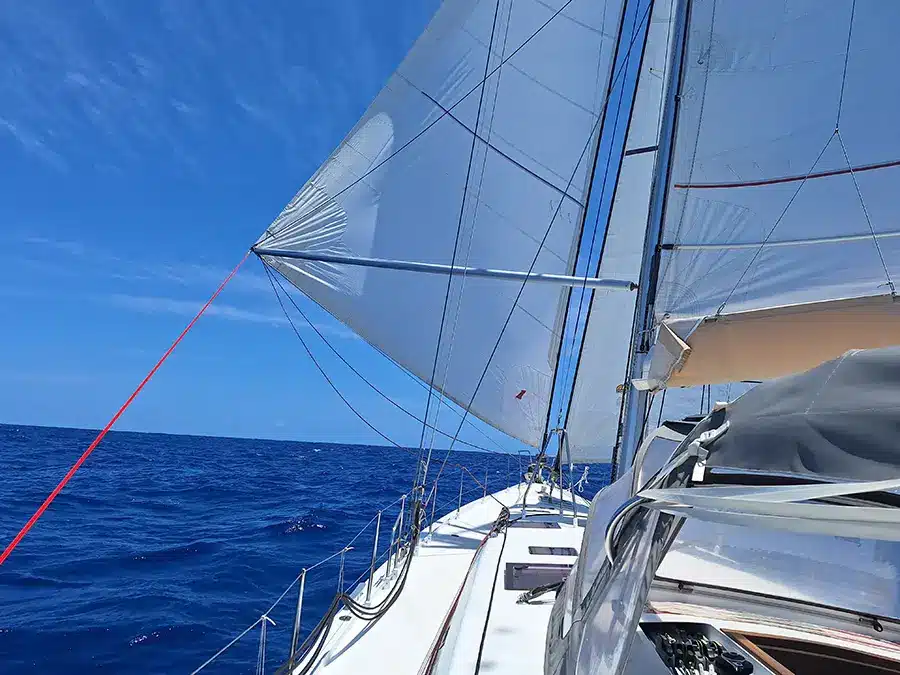
Electric propulsion also offers a particularly interesting possibility for a blue water yacht: motor sailing, the art of intelligently combining engine power with the power of the wind.
When the wind drops and the boat gradually loses speed, low-rev propulsion can support progress under sail. By slightly increasing the boat's speed, the motor helps recreate apparent wind and allows the sails to regain their efficiency.
Rather than dropping the sails as soon as the wind becomes too light, they can therefore stay up and keep driving the boat. A small amount of power can be enough to maintain good speed, while keeping the pleasure of sailing that remains essentially under canvas, calm and quiet.
This approach makes particular sense on a blue water yacht. The aim is not to sail under engine power, but to constantly find the best balance between wind conditions, the boat's progress and the energy available on board.
Electric propulsion lends itself particularly well to this use: its power, immediately available and easily adjustable, can be fine-tuned with great precision to support the sails when needed. Then, once the wind picks up again and the boat naturally regains speed, the motor steps back to leave the sails in full control.
The right amount of power, at the right moment, to extend sailing time under canvas.
A technology in constant evolution
Our experience with the eight OVNIs already fitted with this system confirms we are on the right track and encourages us to continue our research.
The technology keeps evolving: batteries are gaining in capacity and efficiency, motors are improving, energy management systems are becoming more refined, and there is more electrical equipment on board than ever.
In this context, the discussion is no longer just about choosing an engine. It extends to the boat's entire energy architecture.
There is no single solution. Every project calls for a different answer, depending on the sailing programme, the level of autonomy sought, on-board habits, energy needs, the number of people on board and the horizons you wish to explore.
At ALUBAT, our role is to guide you through this thinking, to design an energy solution that is consistent with the way you sail and your voyage plans.
Propulsion tailored to your project
At ALUBAT, we do not see electric propulsion as a single answer meant to systematically replace the diesel engine.
The 50 hp Volvo engine remains a proven option, suited to many blue water sailing programmes.
Electric propulsion, meanwhile, opens up new possibilities for sailors who value quietness, energy autonomy and a more holistic approach to managing energy on board.
Our role, then, is to help guide this choice, to identify the solution best suited to your programme and your way of sailing.
And because technology keeps evolving, we continue our research with the same commitment: putting innovation at the service of freedom, autonomy and the pleasure of sailing.
If you would like to follow OVNIs fitted with electric propulsion, feel free to check out: