

Photo credit : © Jean-Paul C. - OVNI 490
Centreboard, fixed keel, bilge keels or lifting keel: How do you go about choosing an aluminium sailing yacht?
When choosing a sailing boat designed for blue water voyaging, the type of keel is far more than a technical decision. It determines the draught, the boat’s behaviour under sail, access to anchorages and, depending on the configuration, the boat’s ability to take the ground.
At Alubat, the choice was clear right from the founding of the shipyard: the centreboard, which over the course of decades has become one of the defining features of the OVNI’s DNA. From the earliest models back in 1973, the concept was designed to offer sailors extra freedom: the freedom to adjust their boat’s draught and thereby extend their sailing grounds.
Centreboards: The freedom to reduce draught
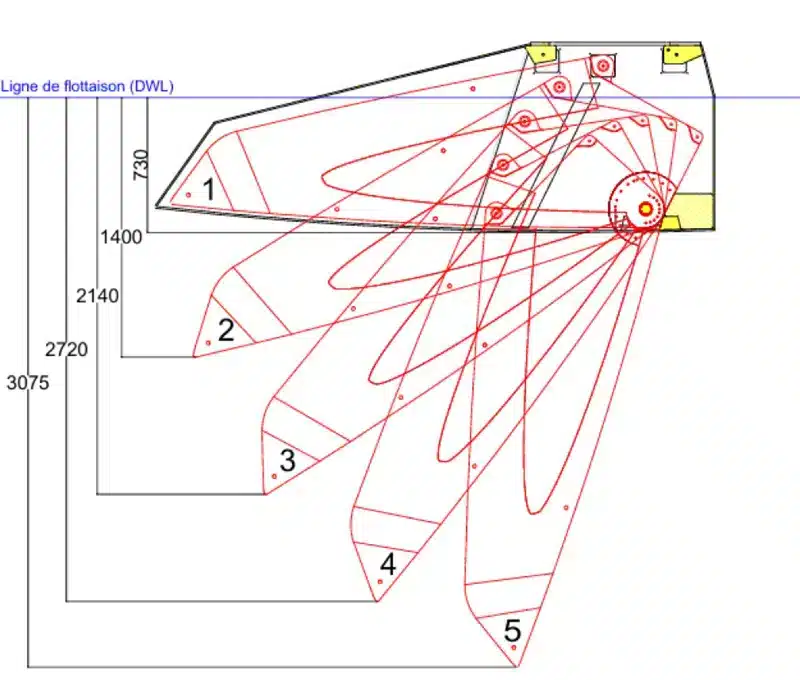
On a centreboard yacht such as the OVNI, the ballast is integrated into the hull, around the centreboard casing. When the centreboard is lowered, it complements the anti-heeling structure and contributes to the boat’s sailing performance. Equally, it can then be raised completely inside the hull, significantly reducing the draught.
This configuration allows the boat to adapt to different sailing conditions. With the centreboard down, the yacht benefits from a deep draught, which optimises performance for sailing close to the wind. With the centreboard up, its shoal draught enables it to access shallow waters.
On the OVNI 370, for example, the draught ranges from 3.08 m with the centreboard lowered to just 92 cm with the board raised. Furthermore, the centreboard constitutes only part of the ballast: the boat has 3,000 kg of ballast, plus the 260 kg of the centreboard itself.
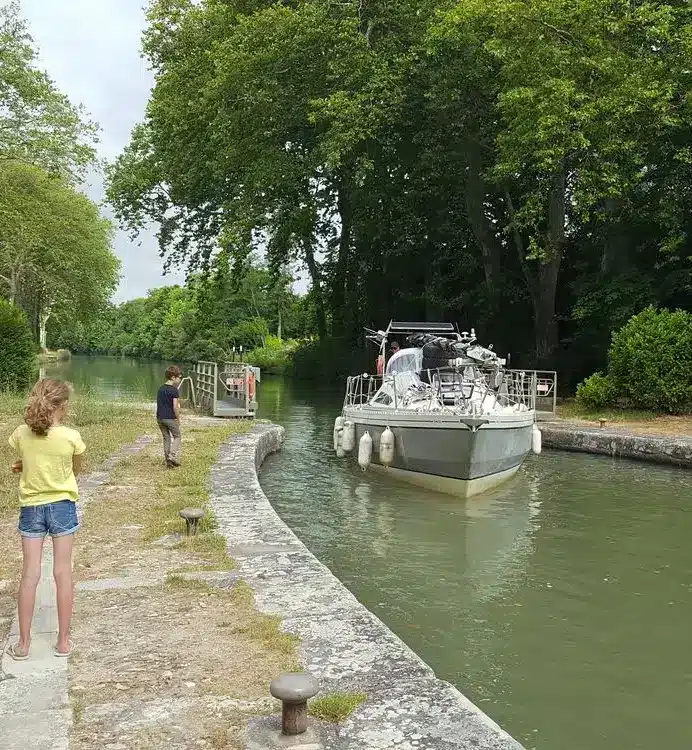
And it’s this ability to vary the draught that opens up new horizons: shallow anchorages, lagoons, rivers, channels, coves or harbours accessible only at certain times of the tide. These are all places that remain inaccessible to yachts with fixed keels.
Combined with the twin rudders, the raised centreboard provides stable yet high-performance handling when sailing downwind, minimising “tripping” effects when luffing or surfing down a wave. This configuration helps make the OVNI a particularly safe and composed boat when sailing downwind or running from heavy weather.
The centreboard therefore offers valuable freedom for long-distance cruising: the freedom to choose your route and stopovers without letting the depth of water dictate your itinerary.
A simple and
accessible mechanism
On an OVNI, raising and lowering the centreboard uses a deliberately simple system: a manual manoeuvre using a line and a block and tackle. The line is routed back to the cockpit via the compression post so that the manoeuvre can be carried out from a central, accessible and safe position. It can also be assisted by an electric winch.
A safety mechanism is also provided in the event of the centreboard touching the bottom: if the holding line is released, the board raises automatically.
This simplicity is part of the OVNI philosophy: to have an efficient, straightforward and easy-to-use system, even for a short-handed crew.
Another freedom: the ability to take the ground
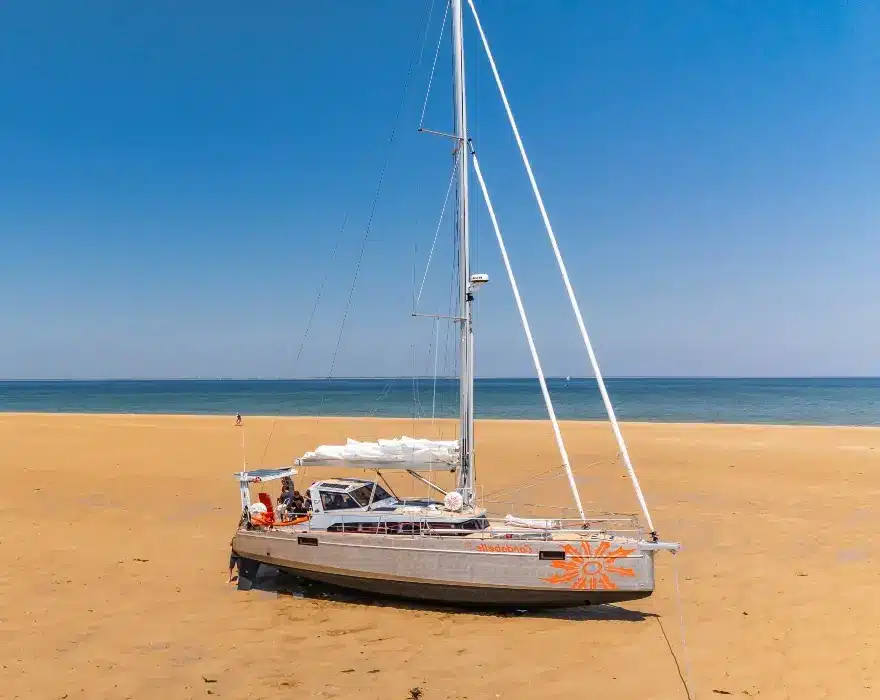
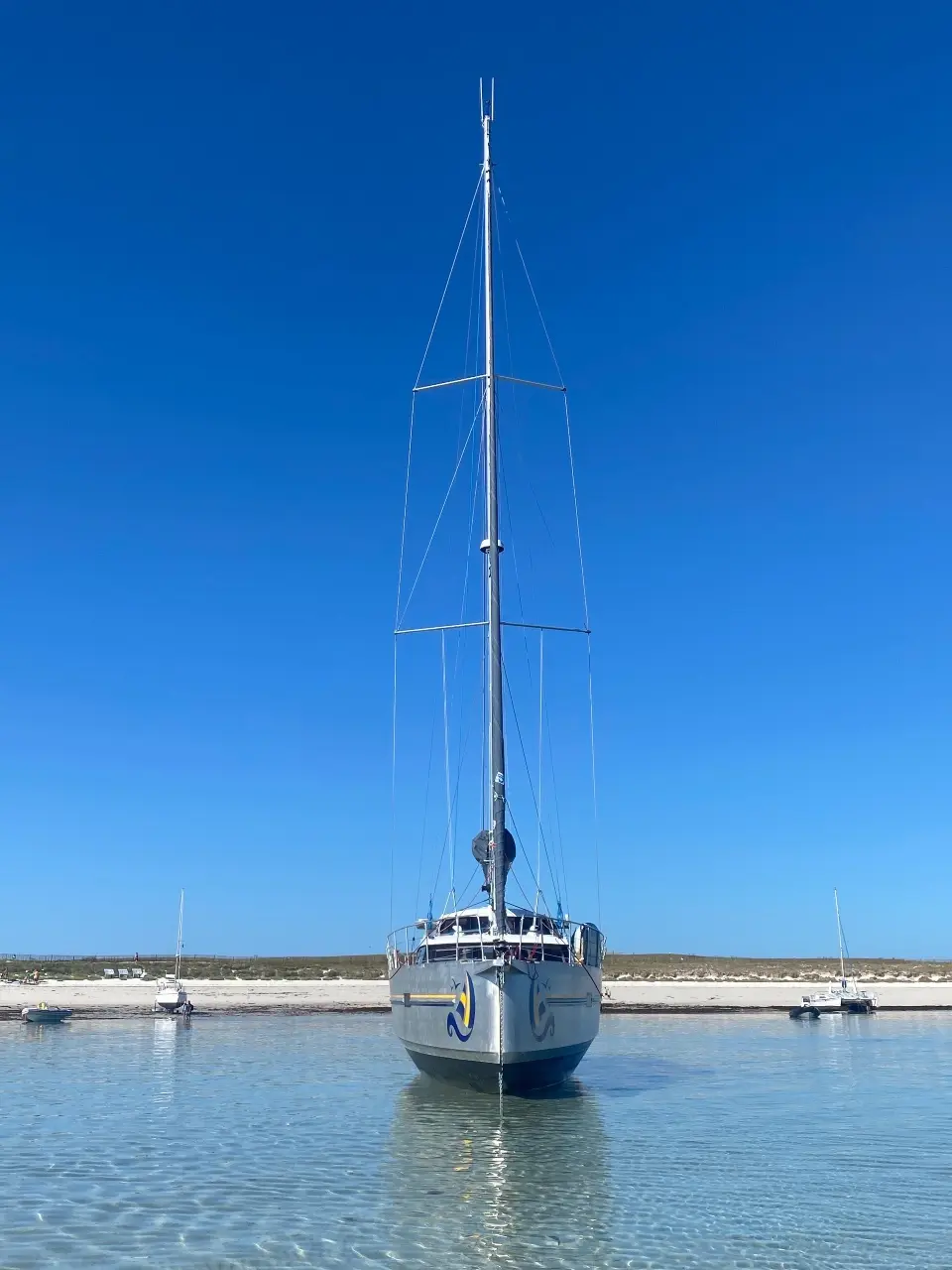
The shoal draught is not only an advantage for sailing in shallow waters. It also allows the boat, under certain conditions, to be beached.
Thanks to their design, OVNI boats can take the ground on the sand to inspect the underwater hull, carry out certain maintenance tasks or checks or, quite simply, enjoy a spot inaccessible to others and live to the rhythm of the tides.
The shape of the underwater hull plays a key role here. The flat bottom plating allows the boat to sit stable and completely flat on the ground. The propeller shaft’s skeg keel protects the prop and the shaft when the boat settles on the sand.
The twin rudders, meanwhile, are spaced apart and are angled. Depending on the fall of the beach on which the boat rests, they may come into contact with the sand, but they are not designed to bear the boat’s weight.
It is this entire design - and not just the fact that there’s a centreboard - which enables the OVNI to take full advantage of its shallow draught.
Crédit photo : © Voilier Libre - Claire Dubois
But centreboards are not the only solution
While centreboards are particularly well-suited to sailors wishing to maximise their options for exploration, they’re not the only solution for every scenario.
Shipyards building aluminium sailing boats now offer several design philosophies: fixed keels, twin keels, lifting keels or centreboards. Each has its own advantages, and each involves certain compromises.
The choice therefore depends above all on your programme, the intended sailing grounds and the priorities you wish to emphasise.
FAQ
The centreboard offers exceptional freedom of sailing. This is precisely the philosophy that has guided the OVNI range since the very beginning.

